WHAT YOU NEED TO KNOW
- Trump’s claim that he knows “more about everything” reflects a governing style built on personal authority rather than evidence or expertise.
- The boast accompanied a $5,000 payment proposal tied to Republican control of Congress, with few details about its funding or implementation.
- His dismissal of experts, journalists and institutional checks is part of a long-running effort to portray disagreement as corruption or disloyalty.
- The article argues that America needs leaders who listen, accept correction and respect democratic institutions—not a president demanding to be treated as infallible.
Donald Trump’s latest boast is so preposterous that it practically begs to be treated as comedy.
“I know more about everything than anybody in this room, anybody anywhere in the world,” he declared at a midterm campaign rally in Vandalia, Ohio, on Saturday.
But the line should not be dismissed as another bit of Trumpian performance art. It is a concise statement of how he believes power should work: The leader speaks, reality rearranges itself and everyone else is expected to applaud.
The context makes the claim even more revealing. Trump was promising $5,000 to every adult American if Republicans retain control of Congress. He said the payment could be financed by tariff revenue and the economic success he attributes to his administration, estimating the total cost at roughly $1 trillion.
President Trump: I know more about everything than anybody anywhere in the world.
— Leading Report (@LeadingReport) October 6, 2026
Then, as if audacity were a substitute for arithmetic, he certified his own proposal by announcing that he knows more about inflation—and apparently every other subject—than anyone alive.
That is not economic analysis. It is the political equivalent of writing “trust me” across a blank spreadsheet.
The routine is familiar. Trump has claimed superior knowledge of ISIS, tax law, renewable energy, courts, campaign finance, construction and numerous other subjects. The point has never been to demonstrate mastery. The point is to make expertise itself seem unnecessary.
Generals can be ignored, economists waved away, scientists mocked and journalists branded enemies because one man has supposedly absorbed all human knowledge through instinct.
This is the language of authoritarianism stripped to its gaudiest essentials. Democracy begins with the opposite premise: No person knows everything, power must be divided, claims must be tested and leaders must be answerable to facts they do not control.
Congress holds hearings. Agencies collect data. Courts demand evidence. A free press asks inconvenient questions. Trump’s cult of omniscience treats every one of those safeguards as an insult to his authority.
His narcissism is getting worse. They need to remove him
— Rooster (@todd20006) October 6, 2026
His $5,000 promise offers a perfect case study. Tariffs are not a magical pile of foreign money waiting to be distributed at a rally.
Federal Reserve researchers reported this year that the tariffs imposed in 2025 raised consumer prices, with lower-income households carrying a disproportionate burden. In other words, Trump is selling voters a check while glossing over the higher prices many of them have already paid to fill the government account he wants to take credit for.
A serious president would provide legislation, revenue estimates, eligibility rules, distribution details and an honest account of the tradeoffs.
Trump offered a number, a partisan condition and a declaration of universal genius. The promise was not presented as policy to be scrutinized; it was presented as a reward that only he could bestow if voters delivered the Congress he wants. That is transactional politics masquerading as populism.
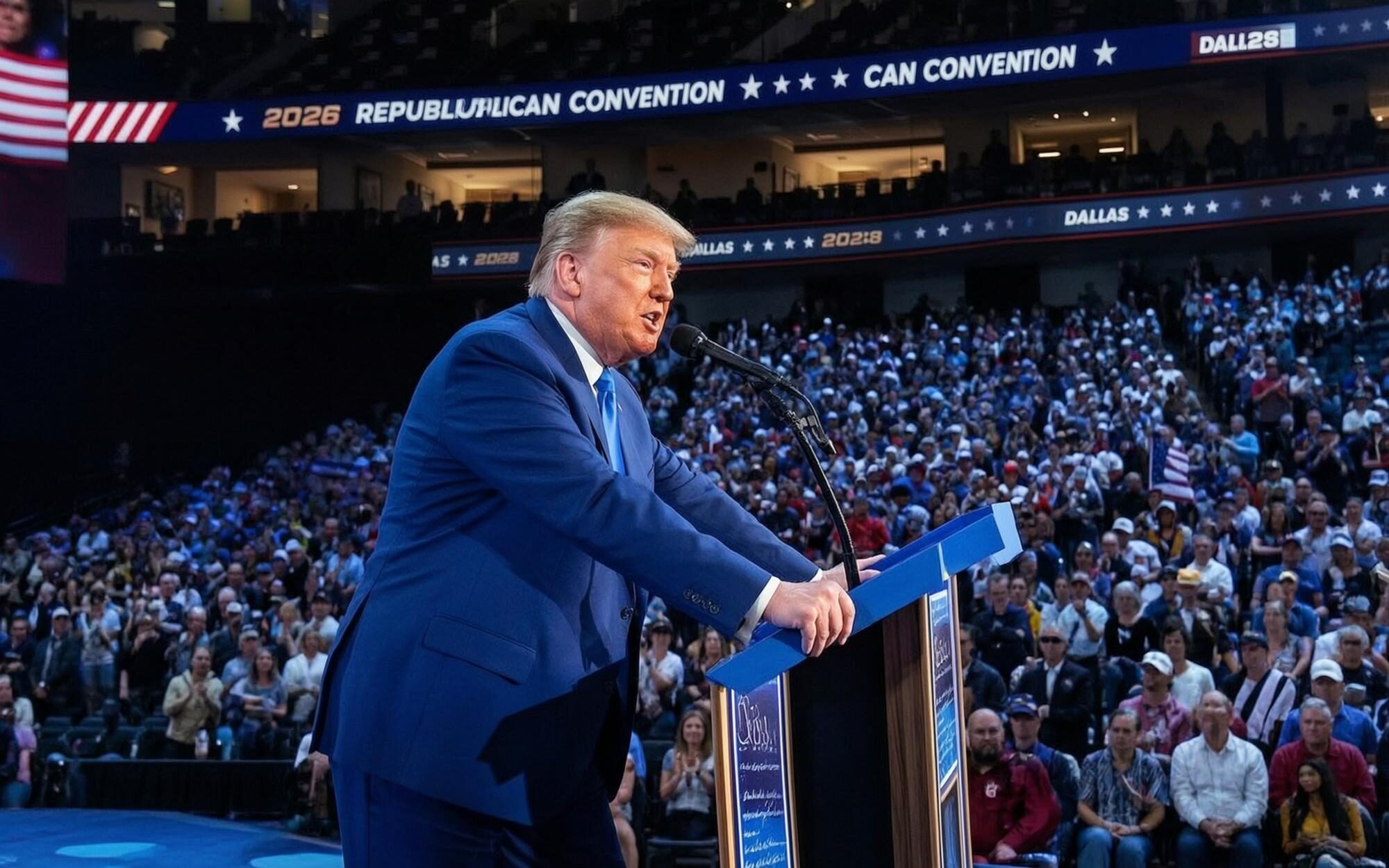
Even Trump’s supposed exception proved the rule. After declaring himself the world’s foremost authority on everything, he pointed to a woman in the audience and said she was a “housewife” with a natural instinct for business who perhaps knew more than he did—before immediately adding, “but I actually don’t think so.”
MORE NEWS: Sotomayor Opens Supreme Court Term with Stark Warning in Case Where a Life Hangs in the Balance
The aside combined condescension, sexism and self-worship in a few efficient seconds. He could not compliment a supporter without first reducing her to a stereotype and then reasserting his dominance.
Defenders will say Trump was joking, exaggerating or simply entertaining a friendly crowd. That defense has followed him for years, always asking Americans to ignore the plain meaning of his words while granting every insult, threat and fantasy the protective status of a punchline.
Well, it’s true. pic.twitter.com/L09QM0bhuW
— America First Annie 🇺🇸 MAGA (@AmFirstMAGA2) October 6, 2026
But presidents do not speak into a vacuum. Their words tell aides what kinds of facts are welcome, tell allies whether dissent will be punished and tell citizens whether government still recognizes a reality beyond the leader’s ego.
The danger is not that Trump literally believes he could outperform every surgeon, physicist or kindergarten teacher on Earth. The danger is that he demands a political system that behaves as though he could. Once a movement accepts the leader as the highest authority on every question, evidence becomes disloyalty.
Bad news becomes sabotage. Oversight becomes persecution. Failure can never belong to the president; it must be blamed on Democrats, immigrants, judges, civil servants, the media or some newly invented enemy.
That pattern was on display throughout the Ohio rally. Trump attacked the press, smeared Democrats as communists and portrayed ordinary political opposition as a sinister force bent on destroying the country.

His claim to know everything was not an isolated burst of vanity. It was the intellectual foundation for the rest of the speech: If Trump is uniquely brilliant, then anyone who disputes him must be corrupt, stupid or malicious.
Liberals should resist the temptation to answer this spectacle only with mockery. Yes, the claim is absurd. Yes, it deserves ridicule. But it also deserves a firm democratic rebuttal.
America does not need an all-knowing ruler. It needs a president capable of listening, learning, admitting error and respecting the people whose expertise makes modern government possible.
Real intelligence is not terrified of correction. Real leadership does not require the humiliation of everyone else. And a healthy democracy never takes any politician’s word for it—especially when he insists that his word is the measure of everything.
Join the Discussion
COMMENTS POLICY: We have no tolerance for messages of violence, racism, vulgarity, obscenity or other such discourteous behavior. Thank you for contributing to a respectful and useful online dialogue.